






In 2025, a growing share of consumers are asking ChatGPT ‘what’s the best air purifier for a small bedroom?’ instead of typing it into Google. When AI responds, it cites a handful of specific products and websites. Everything else doesn’t exist to that buyer. This isn’t a future trend, it’s happening now. And most ecommerce businesses in Vietnam and Southeast Asia have done nothing to prepare for it.
1. The Full Picture: How AI Is Already Changing Shopping Behavior
According to Salesforce Commerce Cloud’s March 2025 report, traffic from generative AI sources (ChatGPT, Gemini, Perplexity, Copilot) to ecommerce websites globally increased by 1,300% year-over-year. The absolute volume is still smaller than traditional Google organic traffic but the growth rate is outpacing every other referral channel.
More significantly: conversion rates from AI referral traffic are consistently 30-50% higher than standard organic search. The reason is straightforward, users arrive having already been ‘advised’ by AI. They come with clearer intent, not to browse. This is a high-value opportunity for businesses that optimize early, before competition catches up.
In Southeast Asia, a YouGov survey from Q1 2025 found that 34% of internet users in major cities had used an AI chatbot at least once to research a product before purchasing, with significantly higher rates among the 18-35 demographic and middle-to-upper income segments. The behavior is adopted and growing.
2. How It Works: The Mechanics Behind AI Shopping Recommendations
Effective optimization requires understanding how AI selects what to recommend. This is not SEO in the traditional sense, AI models don’t crawl the web in real-time for every query (except in browsing-enabled modes). Instead, they draw on three primary sources:
Source 1: The AI model’s training data
ChatGPT, Gemini, and other AI models are trained on vast amounts of web content. Products, brands, and websites that appear frequently in high-authority reviews, articles, forums, and editorial content get ‘learned’ into the model. This is why SEO and content marketing remain critically important in the AI era, not just to rank on Google, but to be learned by the AI.
Read more: AEO: Answer Engine Optimization
Source 2: Real-time web search (when browsing mode is active)
ChatGPT with browsing enabled, Gemini, and Perplexity can all perform live web searches when answering queries. When a user asks ‘what water purifier should I buy for a family of four?’, the AI may search and aggregate information from product pages, review platforms, and ecommerce sites. Websites with clean structured data (schema markup), authoritative content, and clear product information are strongly prioritized for citation.
Source 3: Google Shopping and Product Feeds
Google AI Overview, the AI summary that now appears at the top of many Google search results, directly integrates Google Shopping product feeds. When users search for specific products, AI Overview can display a product carousel pulled directly from Google Merchant Center listings. This is a channel that many businesses in Vietnam are leaving entirely unoptimized.
Read more: What is Google AI Overview
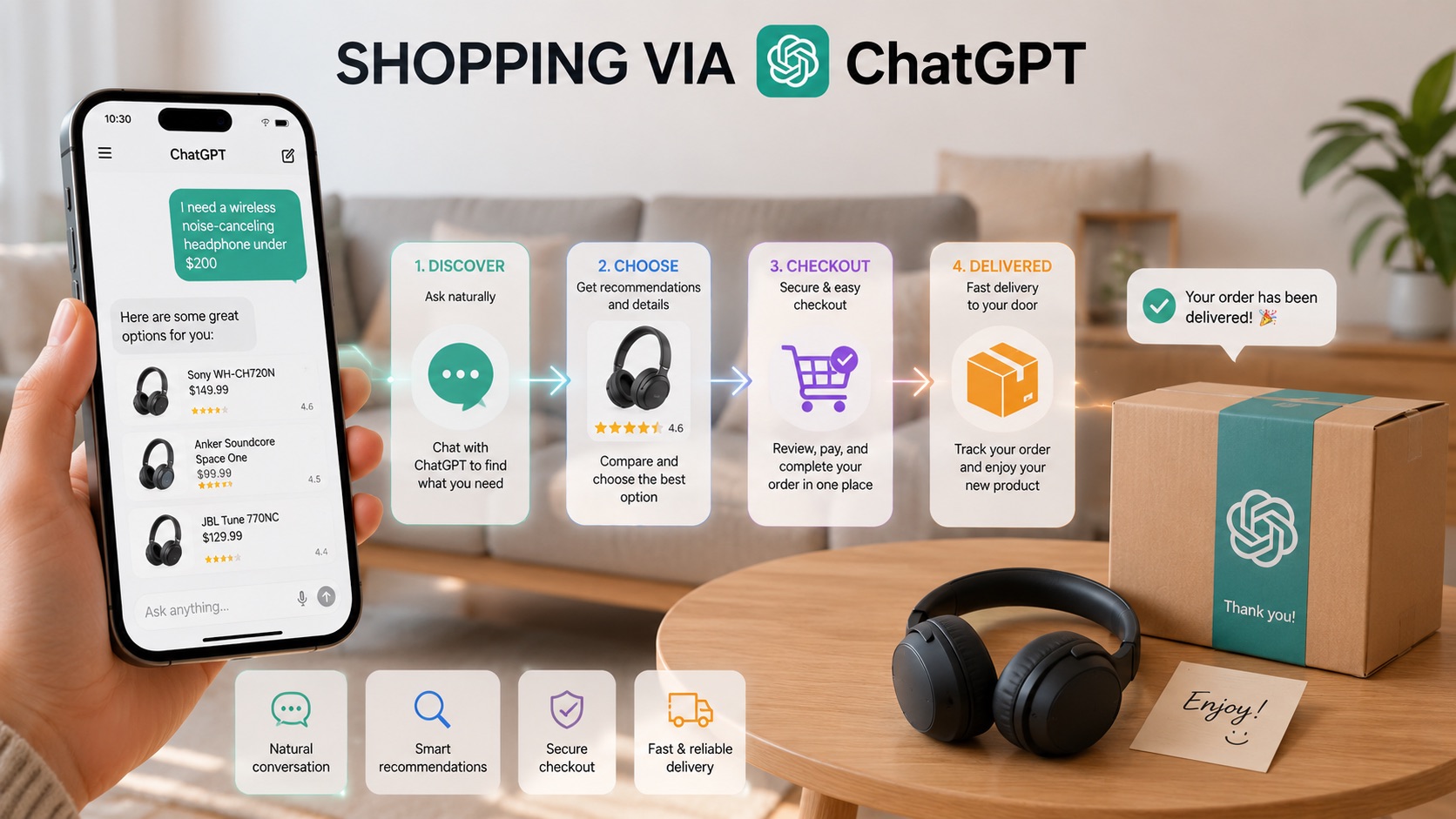
The AI shopping journey via ChatGPT and Gemini vs traditional Google search
3. 5 Optimization Strategies for AI Shopping – With Supporting Data
1. Product Schema Markup, the non-negotiable foundation
Schema markup (structured data) is the language that both Google and AI chatbots use to understand your products. Product schema must include: product name, price, availability, ratings, review count, SKU, and high-quality images. Without it, your product data is invisible to the systems that AI uses to extract and cite.
The data is compelling: according to Semrush’s 2024 research, ecommerce websites with complete Product schema appear in Google AI Overview 67% more often than sites without it. When they do appear, CTR is on average 2.3x higher, because rich snippets display key product information directly in the AI result.
2. Authority Content, so the AI learns your brand
AI models are trained on high-authority content. In practice, this means your brand needs: genuine user reviews on credible platforms (Google Reviews, Trustpilot, relevant forums and communities), in-depth third-party comparison articles that include your products, and press coverage or mentions from credible sources.
The most effective content strategy: build a content hub on your website with comprehensive buyer guides (‘How to choose a water purifier for a family of four’), detailed comparison articles (‘Product A vs B vs C: a complete breakdown’), and FAQ pages optimized for conversational queries. These are the formats AI most readily extracts and cites when answering product questions.
3. Google Merchant Center and Shopping Feed Optimization
This is the most direct path to appearing in Google AI Overview shopping results. A strong product feed requires: real-time updates for stock and pricing, product titles that are descriptive and include key attributes (size, color, material, compatibility), high-quality images on white backgrounds, and zero policy violations.
Google’s own data (Q4 2024) shows that merchants with high-quality Shopping feeds (quality score above 80%) appear in AI Overview shopping carousels 4.2x more often than those with basic feeds. This is one of the clearest ROI opportunities currently available for ecommerce businesses.
4. Optimize for Conversational Queries
AI queries look fundamentally different from traditional search queries. ‘Best air purifier’ is a Google keyword. ‘What air purifier should I buy for a 25 square meter bedroom with a toddler under three, budget around five million VND?’ is an AI query. The specificity of intent is categorically different.
This means your content needs to answer specific, intent-rich questions rather than just targeting short-tail keywords. FAQ pages and product comparison pages written in clear Q&A formats align naturally with how AI extracts and synthesizes information. This is the core of AEO, Answer Engine Optimization, which is increasingly the next layer of SEO strategy.
5. Reviews and Social Proof, the highest-weight signal
AI models are highly sensitive to social proof. Products with substantial, high-quality reviews from real users are significantly more likely to be recommended than those without. Importantly, detail matters more than volume: a review describing specific usage context (‘after 6 months of daily use, the filter still performs well’) is weighted more heavily than a short five-star rating.
Build a systematic review collection process: post-purchase email automation, appropriate review incentives (within each platform’s guidelines), and active responses to existing reviews. AI reads brand responses to reviews, not just the reviews themselves, as a signal of credibility and engagement.
4. Brand.com vs Google Shopping: The Optimal Allocation Strategy
A question many ecommerce businesses are grappling with: should we invest more in optimizing our own website or in Google Shopping? In the AI era, the answer is both, but with distinct strategic roles.
Your brand website serves as the authority hub: the place where AI crawls and learns about your products, brand story, and value proposition. This is where you build trust signals and content depth. Google Shopping serves as the discovery channel: where high-intent buyers search and compare in the moment of purchase. In Google AI Overview, these two channels merge, AI can simultaneously cite content from your website and pull product listings from Google Shopping in a single result.
The strategic implication is significant. According to BrightEdge Research (Q1 2025), 54% of shopping-intent queries on Google now trigger AI Overview. Of those, 71% include both organic content and Shopping product cards. Brands with strong presence in both channels occupy dramatically more SERP real estate than those optimized for only one.
5. Frequently Asked Questions
Is ChatGPT and Gemini actually driving ecommerce revenue?
Yes, and the trend is accelerating. Adobe Analytics data from February 2025 shows AI chatbot referral traffic grew 1,200% year-over-year and now accounts for 1.7% of total ecommerce referral traffic in the US. Small in absolute terms, but growing faster than any other channel. In Vietnam, comprehensive data is still emerging, but the behavioral adoption trend among urban and tech-savvy consumers mirrors global patterns closely.
Can smaller websites realistically appear in AI Overview results?
Yes, and this represents a more level playing field than traditional SEO. AI doesn’t default to domain authority the way Google’s ranking algorithm historically has. It prioritizes relevance and specificity. A smaller website with genuinely deep content, complete schema markup, and authentic high-quality reviews can outperform large sites with generic content. This window of opportunity exists now, before competition for AI citation intensifies.
How is AEO different from traditional SEO?
Traditional SEO optimizes for keyword matching and link authority signals. AEO optimizes for intent matching and information extractability. In practical terms: AEO requires content written in clearer Q&A formats, more complete structured data implementation, and a heavier focus on E-E-A-T (Experience, Expertise, Authoritativeness, Trustworthiness). The two approaches are complementary, AEO builds on a strong SEO foundation rather than replacing it.
How long does it take to see results from AI shopping optimization?
Schema markup and Google Shopping feed improvements can show measurable results within 4-8 weeks. Content authority building and AI training data influence operate on a 3-6 month horizon, since AI model weights don’t update in real-time. The most effective strategy combines quick-win technical improvements (schema, Shopping feed) with parallel long-term content and authority development.