






Still sending emails manually to each customer segment? Tracking leads in Excel? Running campaigns without knowing who engaged where? Marketing automation solves all of this but only when implemented correctly. This guide covers everything from fundamentals to platform selection to the mistakes you must avoid.
1. What is Marketing Automation?
Marketing automation is the use of software to automate repetitive marketing tasks: sending email sequences, nurturing leads through funnel stages, scoring prospects, segmenting audiences automatically, and measuring campaign performance all without daily manual effort.
But it’s more than “automated emails.” At an advanced level, it includes behavioral triggers based on customer actions, dynamic content that adapts per viewer, predictive analytics for purchase behavior, and cross-channel orchestration across email, SMS, ads, and web.
2. Why Vietnamese businesses need Marketing Automation
Vietnam’s digital economy is among the fastest-growing in Southeast Asia. Yet many businesses still operate marketing manually: blast emails to the entire database, sales calls every lead without knowing who’s hot or cold, and nobody tracks the full customer journey.
Marketing automation solves 4 core problems:
- Save time: Repetitive tasks (follow-up emails, lead classification, CRM updates) run 24/7 automatically.
- Increase conversion: Leads get the right content at the right time based on actual behavior no more mass sends.
- Align Marketing & Sales: When leads reach the right score, the system automatically notifies Sales no more ‘Marketing sent leads but Sales didn’t know.’
- Measure ROI precisely: Know exactly which campaigns generated how many leads, deals, and revenue.
3. Core capabilities of Marketing Automation
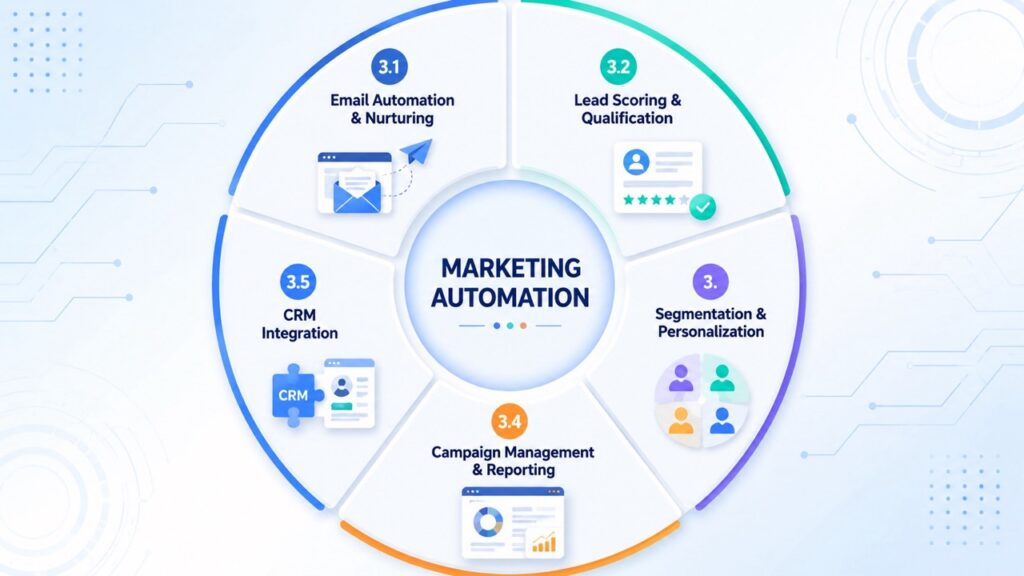
3.1. Email Automation & Nurturing
Design automated email workflows triggered by behavior: welcome series on signup, nurturing based on content consumed, re-engagement when contacts go silent. Each email personalized by name, company, role, and behavior.
3.2. Lead Scoring & Qualification
Automatically score leads based on fit (job title, company size, industry) and engagement (emails opened, pages viewed, forms submitted). When leads hit the threshold, the system routes them to Sales.
3.3. Segmentation & Personalization
Automatically segment audiences by behavior, demographics, or lifecycle stage. Deliver relevant content to each group instead of one-size-fits-all messaging.
3.4. Campaign Management & Reporting
Manage multi-channel campaigns from one place. Measure beyond vanity metrics, track from impression to click to pipeline to revenue attribution.
3.5. CRM Integration
Marketing automation must connect tightly with CRM for unified customer data. This foundation powers every decision from campaign optimization to sales forecasting.
4. Which platform should you choose?
4.1 HubSpot Marketing Hub
Ideal for SMEs starting their automation journey. Intuitive interface, easy learning curve, free CRM included. Strong in inbound marketing, content management, and workflow automation. Tvia Collab is a HubSpot Solution Partner in Vietnam.
4.2 Salesforce Marketing Cloud / Pardot (MCE)
Suited for enterprises or existing Salesforce CRM users. Powerful B2B automation, ABM capabilities, and enterprise-level features. More complex and costly than HubSpot but more flexible for advanced use cases.
4.3 Local CRM Solutions (CloudGO)
For businesses needing Vietnamese-language, industry-specific CRM: healthcare, education, hospitality, retail. Cost-effective with vertical specialization. Tvia Collab is CloudGO’s strategic consulting partner.
5. 5 common implementation mistakes
- Automation without strategy: Activating workflows before designing funnel and customer journey leads to wrong messages at wrong times.
- Using it only for email blasts: Paying premium fees but only sending weekly newsletters wasting 80% of capabilities.
- No lead scoring: Sending all leads to Sales without distinguishing hot from cold, Sales wastes time, Marketing loses credibility.
- Ignoring data quality: Automation on dirty data means wrong names, wrong companies, wrong segments. ‘Dear {FirstName}’ is the telltale sign.
- Implementing without training: Buying the tool, team can’t use it. After 3 months, back to Excel.
6. How Tvia Collab ensures successful implementation
Tvia Collab doesn’t just install platforms, we partner from strategy through execution. Our 7-step process: Marketing Assessment → Sales & Marketing Integration → Tech Analysis → Solution Proposal → Live Demo → Implementation & Training → Managed Services. As a HubSpot Solution Partner with Salesforce MCE/Pardot experience, we help you choose right, implement right, and train your team to operate independently.
7. Frequently Asked Questions
Is marketing automation suitable for small businesses?
Absolutely. HubSpot offers free CRM and low-cost Starter plans, letting SMEs begin with email automation, forms, and basic CRM, then upgrade as needed.
How long does implementation take?
Basic onboarding: 4-6 weeks. Comprehensive implementation with lead scoring, automation workflows, and CRM integration: 8-12 weeks. Timeline depends on business complexity and number of use cases.
Does marketing automation replace marketing staff?
It liberates them. Teams automate repetitive tasks to focus on strategy, creativity, and analysis, higher-value work that drives growth.
What does implementation cost?
HubSpot licenses start from $20/month (Starter), enterprise from $3,600/month. Tvia Collab’s consulting implementation starts from $3,500 depending on scope.
READY TO START WITH MARKETING AUTOMATION?.
Tvia Collab is a HubSpot Solution Partner, consulting and implementing marketing automation for Vietnamese businesses – from platform selection to team training.
📧 contact@tviacollab.com |
📞 093.340.3565 |
📍 No. 6, Vo Van Kiet Street, Saigon Ward, Ho Chi Minh City