






A low cost per lead looks great on a media report and terrible on a P&L. If you sell to affluent, high-consideration buyers, international schools, premium real estate, healthcare, niche services chasing cheap leads usually means chasing the wrong audience. Here’s a full-funnel performance marketing framework built for customers who take months, not minutes, to decide.
1. Why Low CPL Does Not Always Indicate Success
Optimizing CPL for Performance Marketing
Every performance media dashboard rewards the same thing: a low cost per lead. But CPL only measures how cheaply a form was submitted, it says nothing about whether the person submitting it can actually afford, or is actually ready for, what you’re selling.
Ad platforms optimize toward whoever is easiest to convert into a click, not whoever is most likely to buy. When teams chase CPL as the primary KPI, three things happen quietly: lead volume grows faster than sales or admissions teams can follow up with quality; content built to spark curiosity draws clicks without communicating real value or fit; and offline outcomes, enrollments, signed contracts, completed site visits never get reported back to the platform, so the algorithm keeps optimizing for the wrong signal.
The cheapest lead can become the most expensive lead when it consumes sales resources without creating real pipeline.
Read more: Elevate Your Brand with #Growth Marketing
2. What Makes High-Value Customer Acquisition Different
Mass-market campaigns and high-value campaigns are not the same discipline wearing different budgets. Mass-market acquisition sells to a large audience that decides relatively fast, where volume and CPL are the right KPIs. High-value acquisition sells to a narrow, specific audience with a long consideration cycle, multiple stakeholders, and a purchase that usually requires a consultation, a visit, or a face-to-face meeting.
Recognizing this distinction upfront changes how you plan budget, set timelines, and most importantly, define what “success” means for a campaign. A performance marketing plan built around qualified demand looks structurally different from one built around volume.
3. Why Affluent Targeting Is Not Enough
Treating “affluent” as a single targeting checkbox, an income filter, a luxury-interest category, a job title list, rarely produces a reliable audience. High-value customer acquisition works best when multiple signals are layered together: geographic and location data, search intent, language and nationality context, professional and lifestyle context, content engagement behaviour, first-party customer data, CRM and offline conversion data, and event or consultation behaviour.
This layering is what separates a genuine targeting strategy from a targeting guess. A prospect who fits an income bracket but has never engaged with your content or shown location-relevant intent is a much weaker signal than one who fits several of these dimensions at once.
4. A Full-Funnel Performance Marketing Framework
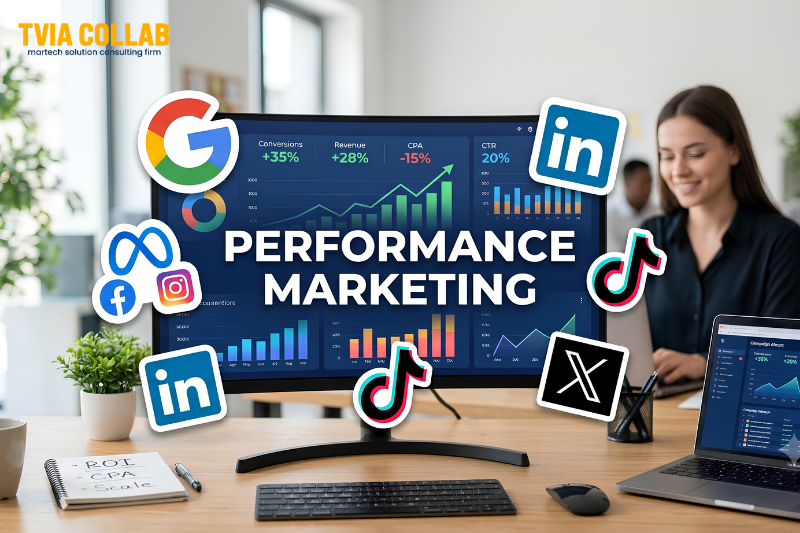
How to Improve Performance Marketing Performance
Media, content and CRM are usually run by different teams or vendors, which is exactly where the customer journey breaks. A full-funnel framework treats acquisition as one continuous loop rather than a series of disconnected campaigns:
- Market Definition → Audience Signals → Trust-Building Content
- Intent Capture → Lead Qualification → Consultation / Visit / Appointment
- Commercial Conversion → CRM Feedback to Media
The last step, feeding CRM and offline outcomes back into the ad platform, is the one most businesses skip, and the one that matters most. Without it, the algorithm never learns what an actual buyer looks like; it only learns what a cheap click looks like.
Segment by Decision Context, Not Just Demographics
For an international school, “parents” is not one audience, it conceals local families, expatriate families, parents researching curriculum, and parents ready to book a visit. For premium real estate, it separates residence buyers from investors, overseas buyers from existing owners. Each stage needs its own message, content and landing page.
Build Trust Before You Ask for a Lead
In high-consideration industries, content doesn’t just attract attention, it reduces perceived risk. Educational content, expert perspectives, proof of quality, and customer stories accumulate into the evidence a prospect needs before they’ll hand over their information.
Match Landing Pages to Intent
A single landing page cannot serve an awareness visitor and a consultation-ready buyer equally well. Awareness pages, programme pages, event pages, and book-a-visit pages each need a clear value proposition, credibility signals, and a form with only as many fields as the moment justifies.
5. The Metrics Businesses Should Track Beyond CPL
A complete measurement framework spans three layers, not one. Media metrics (reach, CTR, CPC, landing page views, form conversion rate) tell you how the campaign performed in isolation. Quality metrics (qualified lead rate, cost per qualified lead, appointment or visit booking rate, show-up rate, opportunity conversion rate) tell you whether the campaign attracted the right people. Commercial metrics (cost per opportunity, pipeline influenced, revenue influenced, customer acquisition cost, payback period) tell you whether it actually grew the business.
Agreeing on a lead qualification model, Inquiry, Engaged Lead, Marketing-Qualified Lead, Sales-Qualified Lead, Opportunity, Customer, with sales or admissions before media even launches is what makes this measurement possible in the first place.
6. Applications in International Education and Premium Industries
We’ve seen this framework applied in two recurring scenarios. An international K–12 school reaching local and expatriate parents across languages and decision stages needs always-on admissions campaigns, landing pages mapped to each objective, school visits treated as a mid-funnel conversion, and CRM follow-up sequenced by language and intake.
A premium or niche service business with a limited addressable market needs the opposite instinct from most media plans: cutting campaigns that generate cheap traffic but no pipeline, using expert content to build trust ahead of the sales conversation, and optimizing toward qualified opportunities instead of form submissions.
7. How Tvia Collab Approaches High-Value Customer Acquisition
Tvia Collab acts as your in-house martech team, connecting customer and audience strategy, performance media planning, multilingual campaign management, tracking and attribution, landing page optimization, CRM and lead lifecycle design, lead nurturing automation, and full-funnel reporting into one operating system, rather than five disconnected vendors reporting five different definitions of success.
Our experience spans customer acquisition programmes for international education, healthcare, technology and premium services across Vietnam and Southeast Asia.
8. Frequently Asked Questions
What is high-value customer acquisition in performance marketing?
High-value customer acquisition refers to marketing strategies built for businesses selling to a narrow, affluent, or high-consideration audience, such as international education, premium real estate, or healthcare, where the sales cycle is long and quality matters more than lead volume.
Why is cost per lead a misleading KPI for premium brands?
CPL only measures how cheaply a form was submitted. It does not measure whether the lead can afford, needs, or is ready for the product, which is why optimizing for CPL alone often lowers overall lead quality.
How do you target affluent audiences effectively?
Effective targeting layers multiple signals, location, search intent, language, professional context, content engagement, and CRM data, rather than relying on a single income or interest filter.
What metrics matter more than CPL for high-value campaigns?
Qualified lead rate, cost per qualified lead, appointment or visit booking rate, opportunity conversion rate, and customer acquisition cost all matter more than CPL because they connect media performance to actual business outcomes.
How does CRM integration improve performance marketing results?
Feeding CRM and offline conversion data back into ad platforms lets the algorithm learn what a real buyer looks like, instead of continuously optimizing toward whoever is cheapest to convert into a click.
| NEED HELP BUILDING A HIGH-VALUE ACQUISITION ENGINE? |
| Tvia Collab helps high-consideration businesses connect media, content, CRM and sales into one measurable growth marketing system. |
| → Book a Free Growth Marketing Consultation |
| contact@tviacollab.com | 093.340.3565 |