






You’re paying an agency to run your digital marketing, but your customer data is scattered across five platforms, your campaigns end without any continuity, and every time you switch agencies you lose your entire history. This isn’t bad luck. It’s the predictable outcome of working with an agency that has no martech stack embedded in its service model. Here’s what that actually costs you, and what a better model looks like.
1. The Traditional Agency Model: Creative Strength, Data Blind Spot
Most digital marketing agencies in Vietnam and across Southeast Asia, were built around a service execution model: run ads, produce content, handle social media, deliver monthly reports. They excel at generating impressions and engagement. But when you ask ‘where is our customer data?’, the answer is typically: scattered across Google Analytics, Meta Ads Manager, and a PowerPoint deck.
The core problem is this: modern marketing is no longer a game of reach and clicks. It’s a game of integrated data, continuous customer journeys, and the ability to activate the right person with the right message at the right moment. That requires a properly architected martech stack, something most traditional agencies don’t own, don’t understand at depth, and don’t include in their deliverables.
2. 3 Concrete Ways Businesses Lose When Agencies Skip Martech
1. The data doesn’t belong to you
When an agency manages your ad accounts, CRM, and email marketing without an integrated system, all your customer behavior data is distributed across disconnected platforms and much of it is effectively owned by the agency, not by you. When the contract ends, you walk away with a report file, not an exploitable customer database.
According to a 2024 Gartner report, 67% of SMEs in Southeast Asia admitted they lack full control over their customer data partly due to dependence on external agencies without proper data governance processes in place.
Read more: HubSpot implementation & CRM
2. No real customer journey exists
Agencies without martech integration typically work in campaign cycles: run campaign A, evaluate results, run campaign B. But your customers don’t live in separate campaigns. They interact with your brand across multiple touchpoints website, email, app, physical store, customer support.
When these touchpoints aren’t connected inside an integrated platform (CRM, CDP, or marketing automation), no one sees the complete picture. The agency reports good ROAS, but customer retention remains low because no one is optimizing the full customer lifecycle.
Read more:CDP and loyalty solutions
3. Hidden costs and indefinite dependency
Every agency switch means re-briefing from scratch, losing data continuity, and losing momentum. But the deeper risk is that you never reach the point where you don’t need the agency, because no internal system is being built. The agency executes but doesn’t transfer knowledge, doesn’t build martech capability inside your organization.
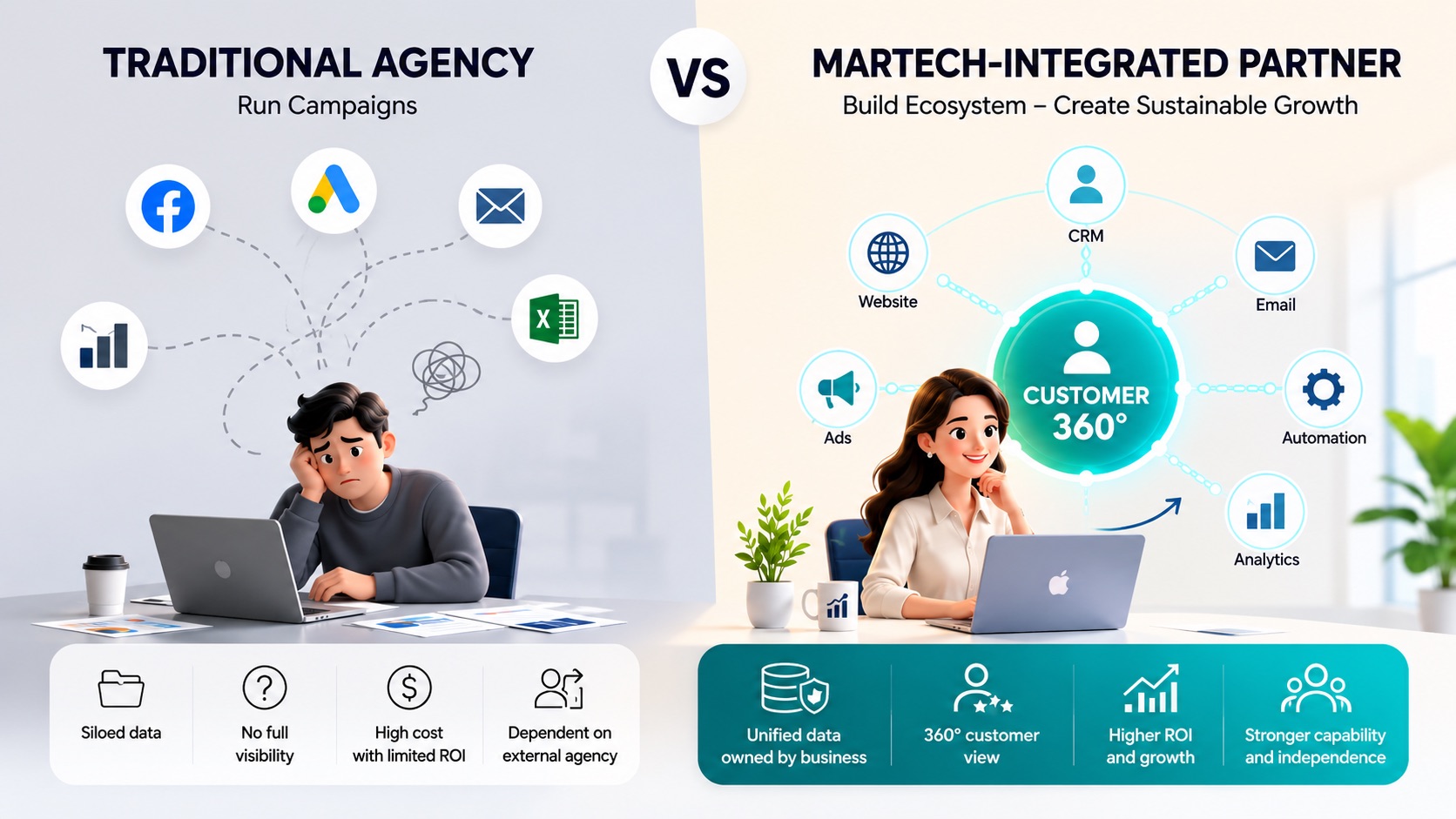
Infographic comparing traditional agency model vs embedded martech partner
4. What Does a Martech-Integrated Agency or Partner Actually Do Differently?
An agency or consulting firm that integrates martech doesn’t just run campaigns, they design your marketing technology ecosystem. In practice, this means:
- Selecting and implementing the right platforms (CRM, CDP, marketing automation, loyalty) based on your specific business model
- Building data flows: from the first customer touchpoint through purchase and retention
- Training your inhouse team to self-operate, reducing dependency over time, not increasing it
- Providing unbiased platform advice, prioritizing your actual ROI, not vendor referral fees
This model is often called an ’embedded martech partner’ or ‘martech consulting + managed services’, not a pure agency, not an IT vendor. They sit at the intersection of marketing strategy and technology execution.
5. When Should a Business Make the Switch?
If you’re experiencing one or more of the following, it’s time to reconsider your current agency model:
- Marketing budget is growing but conversion rate isn’t keeping pace
- No functioning customer data platform or CRM exists in your organization
- Your marketing team can’t read or act on data independently
- Every new campaign requires a full brief because there’s no historical data to build on
- Churn rate is high but the root cause can’t be identified from data
A simple diagnostic question: if you ended your agency contract today, what would you have left? If the answer is ‘some report files and ad accounts’, you’ve been investing in activity, not capability.
6. The Tvia Collab Perspective: The Embedded Martech Partner Model
Tvia Collab was built from exactly this conviction: we don’t want to be an agency you hire and forget. We want to be the inhouse martech team you don’t need to hire full-time.
In practice, this means: we help you choose the right platform (HubSpot, Salesforce, CleverTap, Twilio Segment…), implement and configure it around your actual business processes, and critically, we train your team to own the system. When you no longer need us, that’s success, not a lost contract.
A concrete example: with a large pharmaceutical company in Vietnam, we didn’t just run campaigns. We built a complete martech stack from CRM to marketing automation, trained 25+ employees across 4 departments in 8 hours, and handed over a self-operating system within 3 months.
7. Frequently Asked Questions
What is the difference between a traditional agency and a martech consulting partner?
A traditional agency focuses on executing marketing campaigns, running ads, producing content, handling SEO. A martech consulting partner focuses on building the technology systems, data processes, and self-operating marketing capability within your organization. The two models complement each other, but without the latter, the former only generates short-term activity with no accumulated value.
Do small businesses need a martech stack?
Absolutely. Even a 2-3 person marketing team needs basic CRM and email automation. Cost is rarely the actual barrier, there are solutions for every SME budget. The bigger obstacle is usually not knowing where to start and not having proper implementation guidance.
I’m already using HubSpot but not seeing results. What should I do?
This is extremely common, good platform, poor implementation. The solution is a comprehensive Martech Audit to identify the gap between how you’re currently using the platform and how it could perform at full capacity. Tvia Collab provides Platform Audit and Optimization services for HubSpot, Salesforce, and other platforms.
How do I evaluate whether a martech consulting firm is credible?
Ask them three things: (1) Do they hold certifications from the relevant vendors (HubSpot Solution Partner, Salesforce Partner…)? (2) Do they have experience in your specific industry? (3) When the engagement ends, what do you own? A credible consulting firm will answer all three clearly and without hesitation.