






Using 5-10 marketing tools that don’t talk to each other? CRM data doesn’t match analytics, email tool doesn’t know who bought, and nobody has the full picture? That’s a sign your martech stack needs to be redesigned with strategy, architecture, and integration.
1. What is a Martech Stack?
A martech stack is the collection of marketing technologies a business uses to plan, execute, manage, and measure marketing activities. It includes everything from CRM and marketing automation to email, analytics, CDP, loyalty, SEO tools, and advertising platforms.
An effective stack isn’t ‘more tools = better.’ It’s choosing the right tool for the right function and connecting them into a unified system where data flows seamlessly.
2. The 5 layers of a proper Martech Stack
2.1 Layer 1: Data Foundation
CRM and CDP, where all customer data is stored and unified. Everything else builds on this. Examples: HubSpot CRM, Salesforce, CloudGO, Twilio Segment.
2.2 Layer 2: Automation & Engagement
Marketing automation, email, chatbots, customer engagement. Executes campaigns based on Layer 1 data. Examples: HubSpot Marketing Hub, Salesforce MCE, CleverTap, Iterable.
2.3 Layer 3: Content & Experience
CMS (WordPress, Sitecore), landing pages, personalization. Creates and delivers the right content to each customer.
2.4 Layer 4: Acquisition & Advertising
Google Ads, Meta, LinkedIn, TikTok, SEO tools. Generates traffic and leads. Effectiveness depends on CRM/CDP data connection.
2.5 Layer 5: Analytics & Measurement
GA4, Looker, dashboards. Measures the entire stack’s performance. Must connect to CRM for accurate attribution.
3. Common martech stack mistakes
- “Buy everything”: Adding 2-3 tools yearly without retiring old ones. Stack grows but nobody uses it all.
- “No integration”: Buying CRM from one vendor, email from another, analytics from a third, data doesn’t sync.
- “No operators”: Modern stack but team only uses 20%. Need training or a consulting partner.
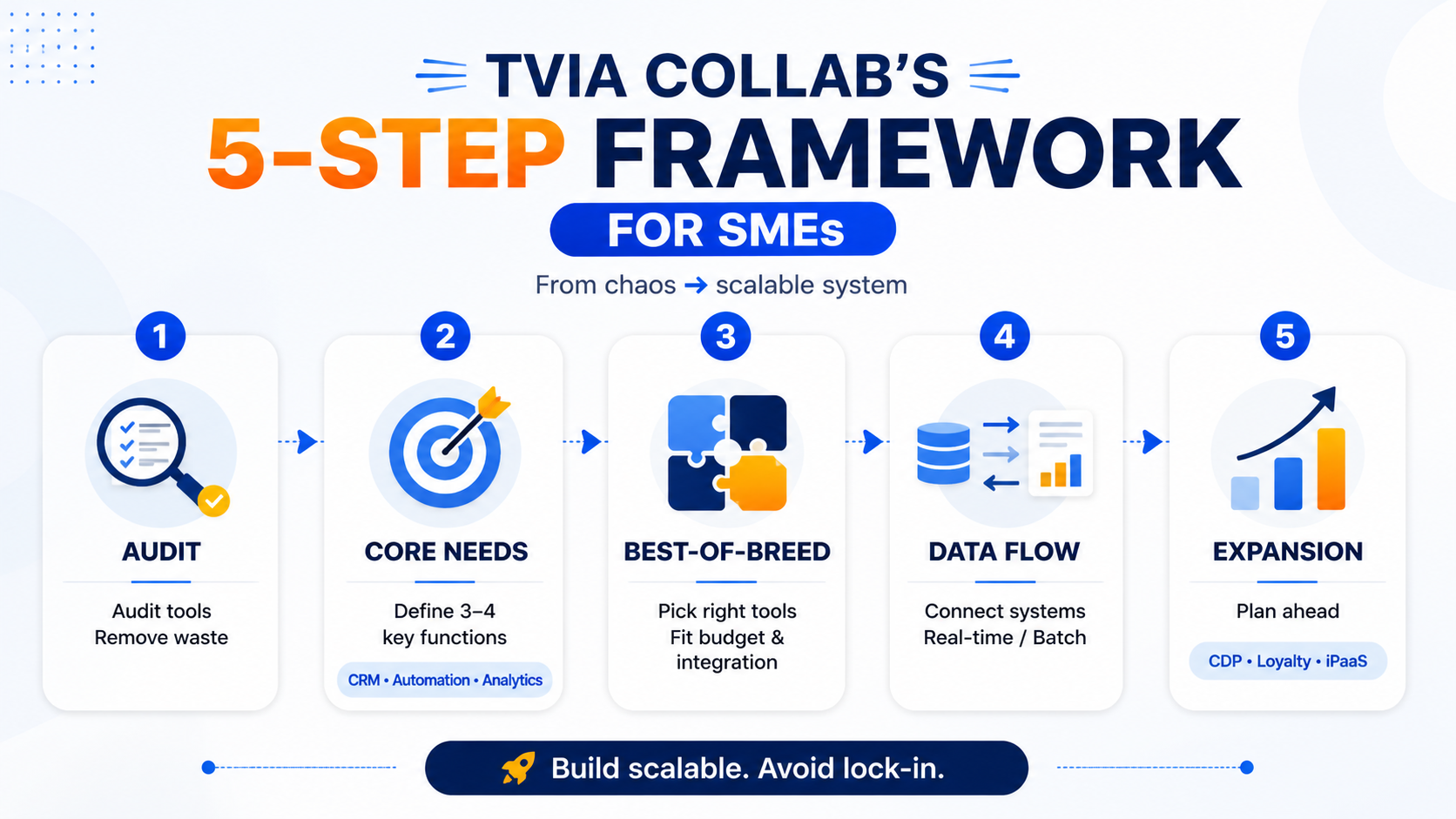
4. Tvia Collab’s 5-step framework for SMEs
- Step 1 Audit: List all current tools. What to keep, what overlaps, what’s wasteful?
- Step 2 Identify core needs: 3-4 critical functions for current stage (usually CRM + Automation + Analytics).
- Step 3 Choose best-of-breed: Pick the best tool per function based on budget, use case, and integration capability.
- Step 4 Design data flow: What data flows between tools, in which direction, real-time or batch?
- Step 5 Expansion roadmap: Plan ahead: when to add CDP, loyalty, integration platform.
5. Tvia Collab: Your Martech Stack architect
With 15+ partners covering all 5 layers, Tvia Collab designs martech stacks for any size and industry. We don’t sell tools, we consult on architecture. Goal: the leanest stack possible, as powerful as needed, easily expandable as you grow.
6. Frequently Asked Questions
What’s the minimum stack for an SME?
Start with 3-4 tools: CRM (HubSpot Free or CloudGO), Email/Automation (HubSpot Marketing Hub), Analytics (GA4), and 1 channel tool (SEO or Ads). Add more as needs grow.
Composable vs all-in-one, which is better?
All-in-one (e.g., HubSpot full suite) is simpler. Composable (best-of-breed per layer) is more flexible. SMEs typically start all-in-one, then shift to composable as scale increases.
Does Tvia Collab audit existing martech stacks?
Yes. Revenue Ops Healthcheck includes a full stack assessment: what’s being used, what’s the utilization gap, and recommended architecture changes.
NEED HELP DESIGNING THE RIGHT MARTECH STACK?
Tvia Collab designs stacks based on real needs, as lean as possible, as powerful as necessary, easily expandable. Start with a Revenue Ops Healthcheck.
📧 contact@tviacollab.com |
📞 093.340.3565 |
📍 No. 6, Vo Van Kiet Street, Saigon Ward, Ho Chi Minh City