






Marketing automation and CRM implementation for FDI companies is the process of assessing existing customer data, choosing the right platform, and reconfiguring marketing-sales workflows to match the Vietnam market, rather than copying the system already running in the company’s home market.
This article walks through the implementation process step by step, the details FDI companies commonly miss, and how Tvia Collab runs this type of project in practice.
1. Why you can’t copy a CRM from the home market straight into Vietnam
You can’t copy a CRM from the home market straight into Vietnam because customer data flow, the primary communication channel, and the lead handoff process between marketing and sales in Vietnam usually differ from the company’s home market. A nurture email workflow that works well in Europe may barely function in Vietnam if the target customer doesn’t check marketing email regularly.
On top of that, sales teams in Vietnam often need lead information in a different format, more detail on budget and decision timing, than sales teams in the home market, since the buying decision cycle in Vietnam can run longer for certain industries.
2. The 7-step process for implementing marketing automation and CRM
The process for implementing marketing automation and CRM at an FDI company has 7 steps: marketing assessment, sales-marketing alignment, tech-fit gap analysis, solution proposal, live demo, implementation and training, and finally ongoing managed service. This process applies to both FDI and local companies, but at the assessment step, FDI companies need an extra layer: reviewing the global CRM already in place to decide what to keep and what needs reconfiguring for Vietnam.
|
Step |
Main activity | FDI-specific note |
| 1. Marketing assessment | Review customer data, marketing channels, tools in use | Identify which parts of the global system can be reused |
| 2. Sales-marketing alignment | Agree on the lead handoff process between the two teams | Compare against the home-market sales process to spot gaps |
| 3. Tech-fit gap analysis | Compare actual requirements against current platform capability | Check integration with the group’s global ERP/CRM |
| 4. Solution proposal | Recommend platform, licensing, and implementation timeline | Cost the proposal in the currency and budget cycle used by the region |
| 5. Live demo | Show how the solution solves the problems identified | Include the regional team if central approval is required |
| 6. Implementation & training | Configure the system, design workflows, train users | Integrate local channels like Zalo OA at this stage |
| 7. Managed service | Ongoing support, consulting on new use cases | Fits Vietnam-based marketing teams, which are often small |
The 7-step process for marketing automation and CRM implementation
3. Three details FDI companies commonly miss when implementing CRM in Vietnam
The three details FDI companies commonly miss when implementing CRM in Vietnam are Zalo integration, syncing currency and local data formats, and underestimating how long centralized headquarters approval takes.
Missing Zalo OA integration in the CRM workflow
Many FDI companies implementing CRM in Vietnam integrate only email and SMS following the global template, missing Zalo OA, the channel most Vietnamese customers expect to be reached through directly. Adding this integration after the system is already live usually takes far more effort than designing it correctly during the initial implementation.
Missing currency and data-format synchronization
A global CRM usually defaults to the currency and date format of headquarters, which causes confusion when the Vietnam sales team enters quotes in VND or uses the local day/month/year format. Configuring this correctly from the start prevents data errors once reports roll up to headquarters.
Underestimating centralized approval timelines
FDI companies typically need technology budget approval from an overseas headquarters, which makes the solution-proposal stage take longer than initially planned. Preparing the proposal document in English with a clear cost comparison against the current system shortens approval time considerably compared with sending a plain quote alone.
4. How Tvia Collab implements marketing automation and CRM for FDI companies
Tvia Collab applies the 7-step process above to every CRM and marketing automation project, starting with a free assessment session to identify which parts of the FDI company’s global system can stay as-is and which need reconfiguring for Vietnam. As a certified partner of HubSpot, Segment, CloudGO, and Ascentis, Tvia Collab can recommend a platform that fits the technology the company already runs in its home market, rather than always defaulting to one fixed platform.
For clients with both B2B and B2C business models, such as the CRM strategy consulting project for Hai San Hoang Gia, Tvia Collab builds separate CRM use cases for each business model rather than forcing both into a single shared workflow.
Tvia Collab is also upfront about the limits: the headquarters approval stage for FDI companies with centralized budget approval typically runs longer than expected, and the implementation team can only speed up the proposal preparation, it can’t shorten the client’s own internal approval timeline.
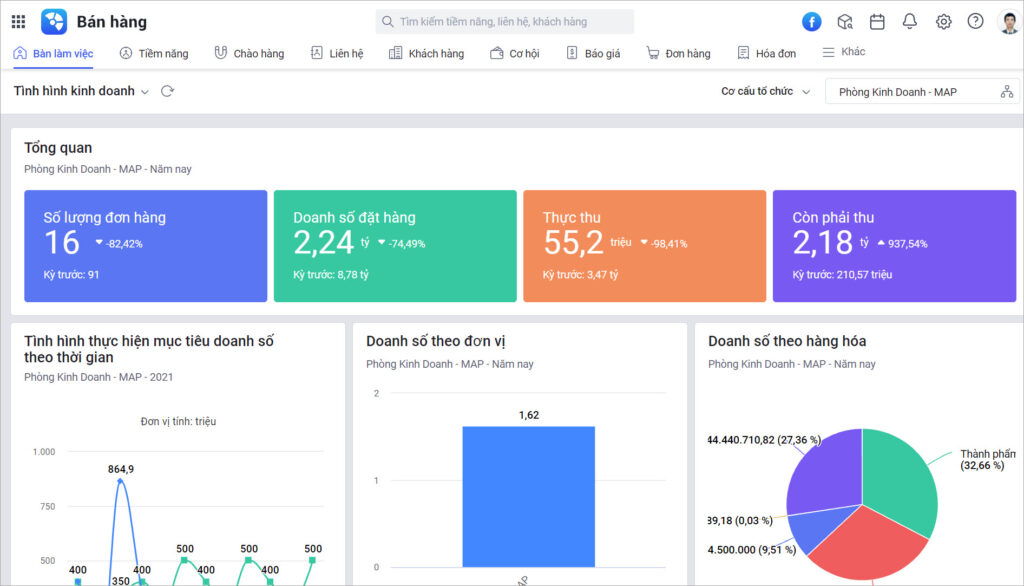 A dashboard showing marketing and sales data synced in one CRM.
5. Frequently Asked Questions
How long does marketing automation and CRM implementation take in Vietnam?
Implementation time depends on the number of use cases and how deeply the system needs to integrate with what’s already in place, typically taking a few weeks for configuration and training once the solution is approved. The budget-approval stage at an FDI company can take longer than the technical implementation itself if it needs headquarters sign-off.
Should you use the global CRM or implement a separate one for Vietnam?
In most cases, it’s better to keep the global CRM platform to maintain data sync with the parent company, but reconfigure the workflows, channel integrations (especially Zalo), and data formats to fit the Vietnam market, rather than standing up a fully separate system.
What steps are involved in CRM implementation for an FDI company?
The process has 7 steps: marketing assessment, sales-marketing alignment, tech-fit gap analysis, solution proposal, live demo, implementation and training, and ongoing managed service once the system goes live.
6. Conclusion
Implementing marketing automation and CRM for an FDI company in Vietnam takes more than reinstalling a familiar platform: it requires correctly assessing which parts of the global system to keep, properly integrating local channels like Zalo, and preparing approval documents that fit a centralized headquarters approval process.
Companies that get this right from the start avoid the cost of reworking the system later. If your company is preparing to implement or optimize a CRM in Vietnam, Tvia Collab is glad to run an initial assessment for your specific situation.